03.03.2026
“Farm Woman and Comrade Machine”
Contact person
Gabriele Blömker
02501 801-1670
gabriele.bloemker@lv.de
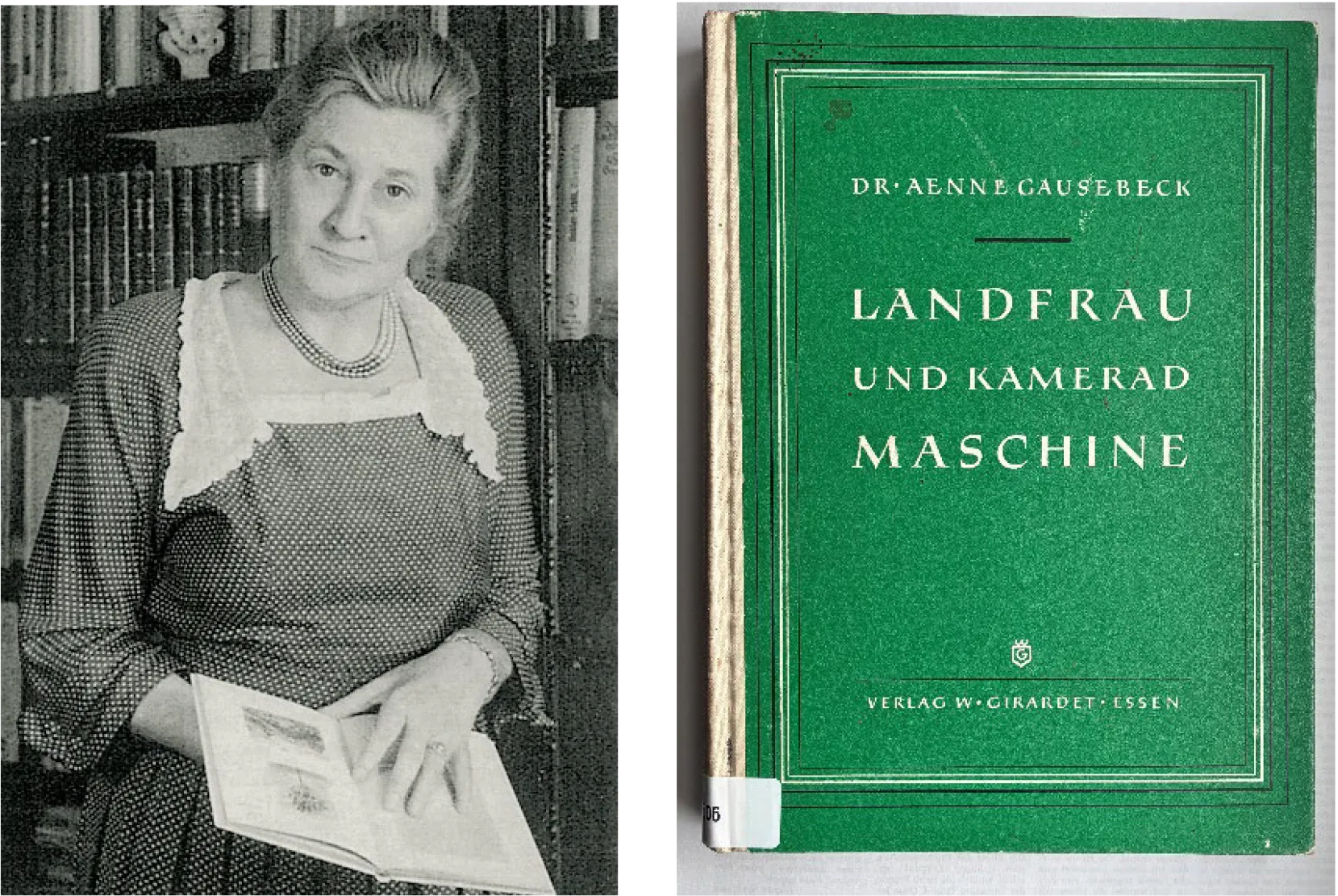
The UN has declared 2026 the “International Year of the Woman Farmer”. Making rural women visible and supporting them – this was also the aim of author Aenne Gausebeck, who hailed from the Münsterland region. As early as 1950, she fully embraced technology for female farmers. This was important because immediately after the war, 290,000 farms – every sixth farm at the time – were managed by women.
What must a female farmer consider when using a plow, harrow, or cultivator in the field? How does a woman start an electric motor? How must water pipes be laid in the house and stable to save farm women the tedious task of hauling water?
Questions like these are the focus of a book titled “Landfrau und Kamerad Maschine” (Farm Woman and Comrade Machine), published in Essen in 1950. The book is part of the collection of the “Westphalian Library of Agriculture” of the Landwirtschaftsverlag Foundation in Münster-Hiltrup and is a special testimony to the early post-war years and the role of women on farms at that time.
The author Aenne Gausebeck directs women's attention not only to housekeeping but to the entire technology on the farm. This had not existed until then. “It is the first book that fundamentally includes the mechanization of the entire outdoor and indoor economy, with field, stable, and yard, from the woman's point of view and women's working life,” the author emphasizes.
Aenne Gausebeck (1890–1969) came from a farming and merchant family in Everswinkel in the Münsterland region. She was an elementary school teacher in Kamp-Lintfort before moving to the Chamber of Agriculture for the Rhine Province in Bonn in 1918. There she was responsible for rural women's education, and later for schools and culture. Gausebeck gave lectures up and down the country and wrote guidebooks for house, farm, and family. Several of her writings are in the collection of the Hiltrup specialist library. They bear titles such as
- “Meine Brautkiste – die Wäsche-Aussteuer der heutigen Jungbäuerin” (My Dowry Chest – The Laundry Trousseau of Today's Young Farmer's Wife, 1938)
- “Vom Kräuterbeet in die Küche” (From the Herb Bed to the Kitchen, 1940)
- “Mein Arbeitstisch – meine Arbeitshilfe” (My Workbench – My Work Aid, 1944)
In the early post-war years, advisory pamphlets such as “Haushaltspflege aus dem Herzen” (Household Care from the Heart), “Ein neuer Hof mit neuen Möbeln” (A New Farm with New Furniture) or indeed “Landfrau und Kamerad Maschine” were published. This book is particularly extensive with 264 pages and almost 400 photographs and drawings.
When it appeared in 1950, agriculture was more of a woman's business than ever. It is largely forgotten: Federal German statistics counted almost 290,000 female owners of agricultural businesses between the North Sea and the Alps at that time. Almost every sixth (!) West German farm was in female hands. This was a direct consequence of the war. Many husbands and farmers' sons had fallen or not returned from captivity as prisoners of war.
Never before had women held such a strong role in agriculture as independent business owners as they did then, in the 1950s. The female farmers, maids, small-scale and part-time farmers could use every bit of support. “Electric power, device, and machine,” wrote Aenne Gausebeck in her book, “should relieve the rural woman of the almost man-sized heaviness of many of her tasks, should therefore be or become 'the comrade' in her hard day's work.”
About the Westphalian Library of Agriculture
The “Westphalian Library of Agriculture” (WBL) in Münster-Hiltrup comprises around 6,500 volumes of practice-oriented specialist agricultural literature from five centuries. A regional focus is on titles from Westphalia-Lippe and Northwest Germany. The collection is owned by the Landwirtschaftsverlag Foundation in Münster and is organized as a reference library. Those interested in agricultural history can search the inventory digitally (WBL Inventory) and use the books on-site by prior appointment.